

A single moderation system now has to account for 184,012,576 removed videos in one quarter. TikTok reported that global removal total for Q1 2026, while YouTube reported removing 69,271,993 videos and terminating 2,183,919 channels during the same period, as summarized by 2026 video moderation statistics. Those figures reframe the problem: video content moderation isn't a simple “approve or reject” feature. It's a production system that combines machine learning, policy, human judgment, access controls, audit trails, and appeals.
The right design depends on what your platform does. A public user-generated-content feed must make fast decisions about material that can spread widely. A private B2B video workflow often has a different risk boundary. The key question may not be “Is this video safe for everyone?” but “Which recipient is allowed to view this file, under which conditions, and for how long?”
Table of Contents
- What Video Content Moderation Actually Means in 2026
- The Three Moderation Models and When to Use Each
- Detection Techniques That Actually Work on Video
- The End-to-End Moderation Workflow
- Policies, Compliance, and the Over-Removal Trap
- Metrics, Appeals, and the Generative Video Problem
- Implementing Moderation on a Secure Video Platform
What Video Content Moderation Actually Means in 2026
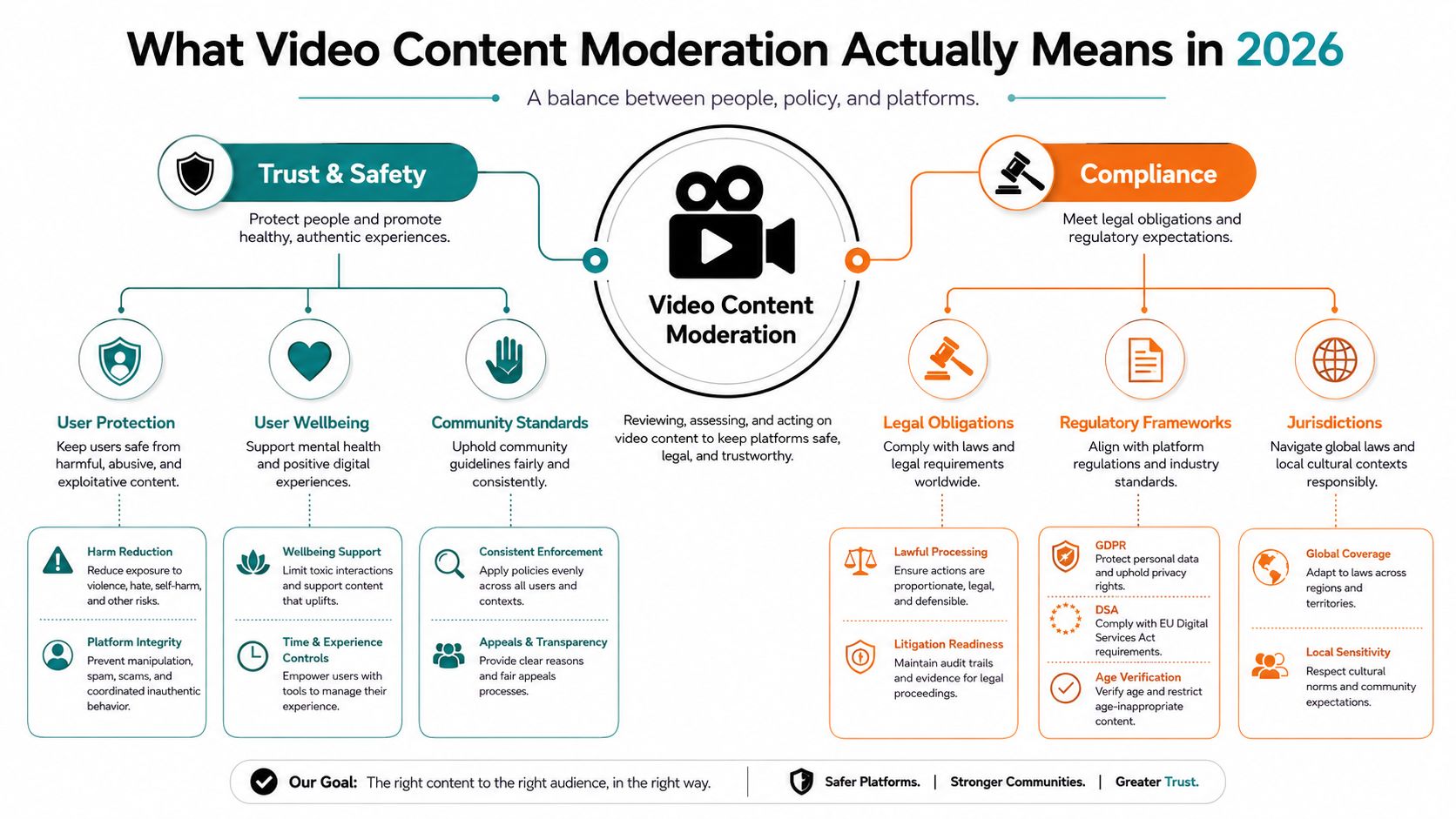
Video content moderation is both a trust-and-safety discipline and a compliance function. Trust and safety teams protect people from abuse, exploitation, harassment, fraud, and harmful material. Compliance teams create evidence that the platform follows applicable rules, handles reports, documents enforcement, and provides appropriate review or appeal paths.
The European Union shows how far this function has moved beyond an internal operations queue. The Digital Services Act transparency database has operated since September 2023, and by December 2023 it contained over 735 billion content-moderation decisions submitted by major platforms to the European Commission, according to independent analysis of EU moderation data. Video represented 24.42% of moderated content in that analysis, behind text at 38.74% and ahead of images at 6.57%, showing why video needs its own operational treatment.
A moderation decision happens at several points
A platform can evaluate a video:
- Before publication, by scanning the upload before playback or distribution.
- During a livestream, by analyzing incoming frames, speech, chat, and viewer reports while the event is active.
- After publication, by reviewing stored assets, user reports, appeals, or new policy signals.
The decision itself is probabilistic. A classifier estimates risk from incomplete evidence, then applies a threshold. A video may contain a dangerous object in a harmless documentary, a slur in a condemnation of hate speech, or an impersonation that looks authentic until audio and provenance signals are examined together. Labels are also imperfect, especially for rare, culturally specific, or rapidly changing violations.
Generative video makes that uncertainty sharper. Synthetic media and deepfakes can evade ordinary file matching, while short-form vertical video compresses context into quick edits, captions, audio, and visual cues. A workable system therefore needs three layers: a policy stack that defines what matters, a detection layer that gathers evidence, and an appeals loop that corrects mistakes. The outcome shouldn't be an unrealistic promise of perfect classification. It should be a defensible process your product team can operate and improve.
The Three Moderation Models and When to Use Each
No single moderation model fits every platform. Automation gives you coverage and speed, human review supplies context, and a hybrid system decides where human judgment creates the most value.
| Dimension | Automated | Human | Hybrid |
|---|---|---|---|
| Scale | Handles very large upload volumes consistently | Capacity is limited by reviewer availability | Automation handles routine volume, people handle exceptions |
| Latency | Suitable for pre-publication checks and rapid triage | Review time varies with queue size and case complexity | Low-risk content moves quickly, uncertain cases pause |
| Strengths | Detects known patterns, matches, and classifier categories | Interprets sarcasm, cultural context, intent, and public interest | Combines repeatable screening with contextual judgment |
| Blind spots | Misses nuance and can fail against adversarial edits | Can be inconsistent and emotionally demanding | Requires careful routing, calibration, and reviewer training |
| Best fit | Known-bad material and predictable policy categories | Appeals, high-impact decisions, and ambiguous evidence | Public UGC, complex policy areas, and livestream escalation |
Use automation for repeatable first decisions
Automated moderation works well when the violation has recognizable visual, audio, textual, or behavioral patterns. It can scan a new upload before users see it, assign a risk score, and send obvious low-risk or high-risk items to different queues. That prevents reviewers from spending time on material that a consistent detector can classify reliably.
Automation shouldn't be treated as a final authority by default. A model may recognize a weapon but not whether the clip is a threat, a game recording, a news report, or a safety demonstration. Thresholds must reflect the consequence of being wrong.
Use humans where context changes the outcome
Reviewers are essential for appeals, public-interest exceptions, satire, cultural references, and cases involving possible impersonation or fraud. They can examine the full sequence rather than isolated frames and use policy guidance to distinguish depiction from advocacy.
Human review also has limits. Fatigue, inconsistent interpretation, language gaps, and exposure to disturbing material affect quality. A human-heavy design can become slow during spikes, exactly when rapid decisions matter most.
Use hybrid routing as the default for public UGC
A hybrid system lets the model handle clear cases and routes borderline scores to trained reviewers. It can also escalate decisions based on severity, not only confidence. A moderately confident classifier result involving a low-impact restriction may follow one path, while a possible child-safety, violent-threat, or account-level enforcement signal should receive a more controlled review.
Operational rule: Automate evidence gathering and obvious decisions. Reserve human authority for ambiguity, severity, and appeals.
For private B2B workflows, the balance often shifts toward pre-screening and recipient-specific access decisions. For public feeds, human review remains more important because the platform is making a broad distribution decision. Livestreams typically need layered controls, with automated interruption signals, moderator intervention, and escalation for severe events.
Detection Techniques That Actually Work on Video
Video creates a sampling problem before it creates a classification problem. A long file contains many redundant frames, but a brief event can appear and disappear between samples. The system must choose where to look, what modalities to combine, and how to use signals outside the file itself.
Sample according to the failure mode
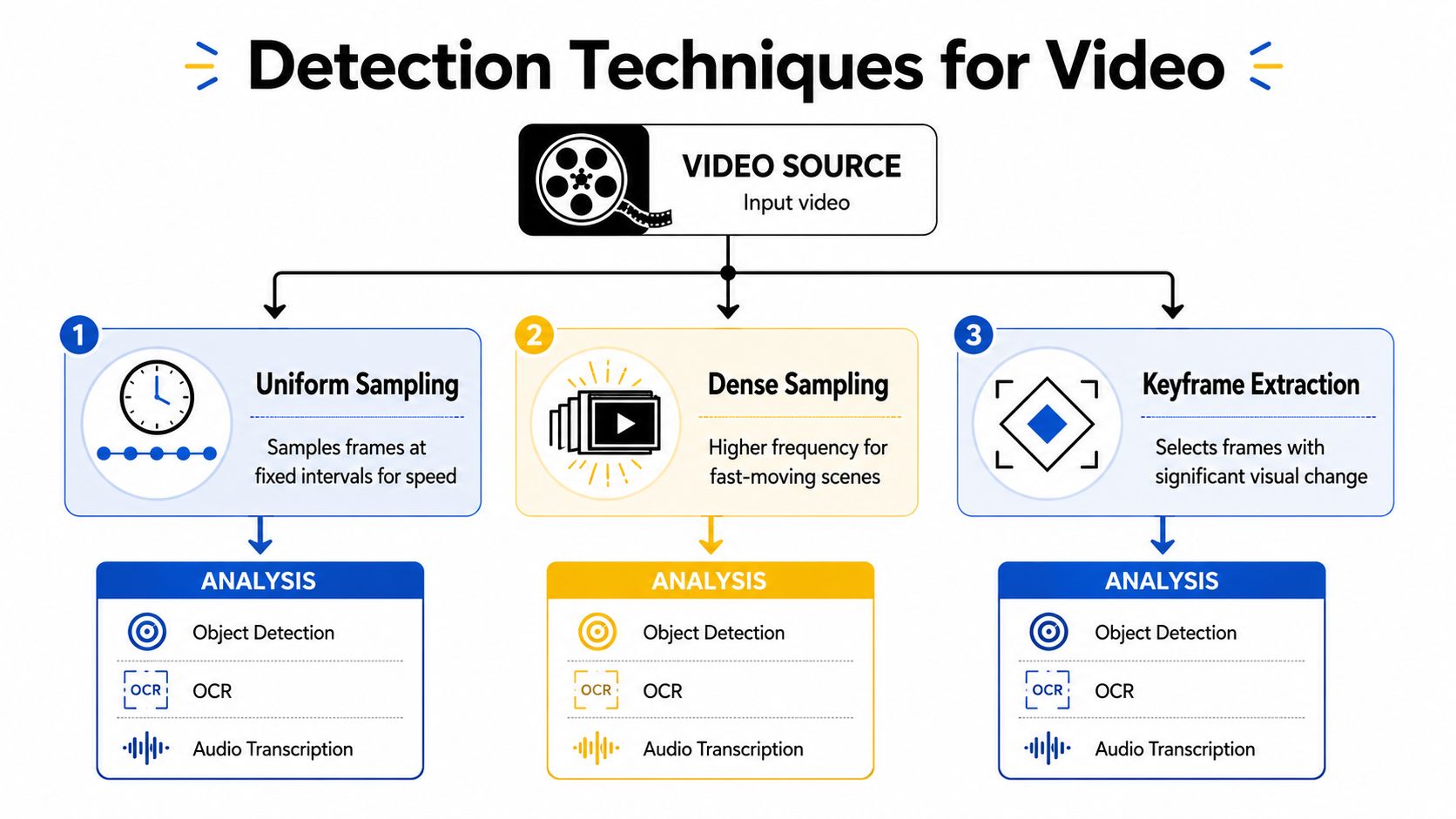
An AWS evaluation guide recommends uniform offline sampling at 0.3 to 1 frame per second, while its managed video API internally samples at 3 frames per second because adjacent frames are highly redundant, as described in the video moderation evaluation research. Sparse sampling lowers compute and annotation demands, but it can miss a brief unsafe event. Dense sampling is more appropriate for fast movement, sudden violence, or livestream scenes where timing matters.
Keyframe extraction offers a third option. Instead of checking every frame equally, the system selects frames with meaningful visual change, then applies object detection, OCR, or scene analysis. It can reduce redundant processing, but the change detector itself needs testing because a subtle policy-relevant event may not create a dramatic visual transition.
Combine modalities instead of trusting the picture alone
A multimodal classifier can fuse:
- Visual features, such as people, objects, gestures, scenes, and editing patterns.
- Audio transcription, which can reveal threats, instructions, slurs, or fraud language.
- On-screen OCR, which captures captions, phone numbers, URLs, and embedded claims.
- Metadata and behavior, which adds context about the uploader and distribution pattern.
These signals solve different video-specific problems. Audio catches spoken content that never appears visually. OCR catches text hidden inside the frame. Motion and sequencing distinguish a still image from an event. Behavioral signals can identify coordinated abuse even when each individual video looks acceptable.
Perceptual hashes and strong fingerprints help match known material after re-encoding, cropping, or resizing. They're useful for previously identified abuse, but they won't detect a newly generated deepfake or a legitimate clip repurposed with harmful narration.
For a practical foundation, review best practices for moderation, then test every detector against the failure mode it's meant to address. A frame sampler should be judged on missed brief events. OCR should be tested on overlays and low-quality text. Behavioral rules should be tested for unfairly penalizing new or legitimate accounts.
Recent benchmarks reinforce the need for category-level evaluation. One 2025 multimodal benchmark used 1,500 videos across three risk categories, while another short-video benchmark used 1,000 real-platform videos across 15 violative types, according to research on multimodal moderation benchmarks. Aggregate accuracy can hide failures in rare, high-severity classes, so measure confusion by policy category.
The End-to-End Moderation Workflow
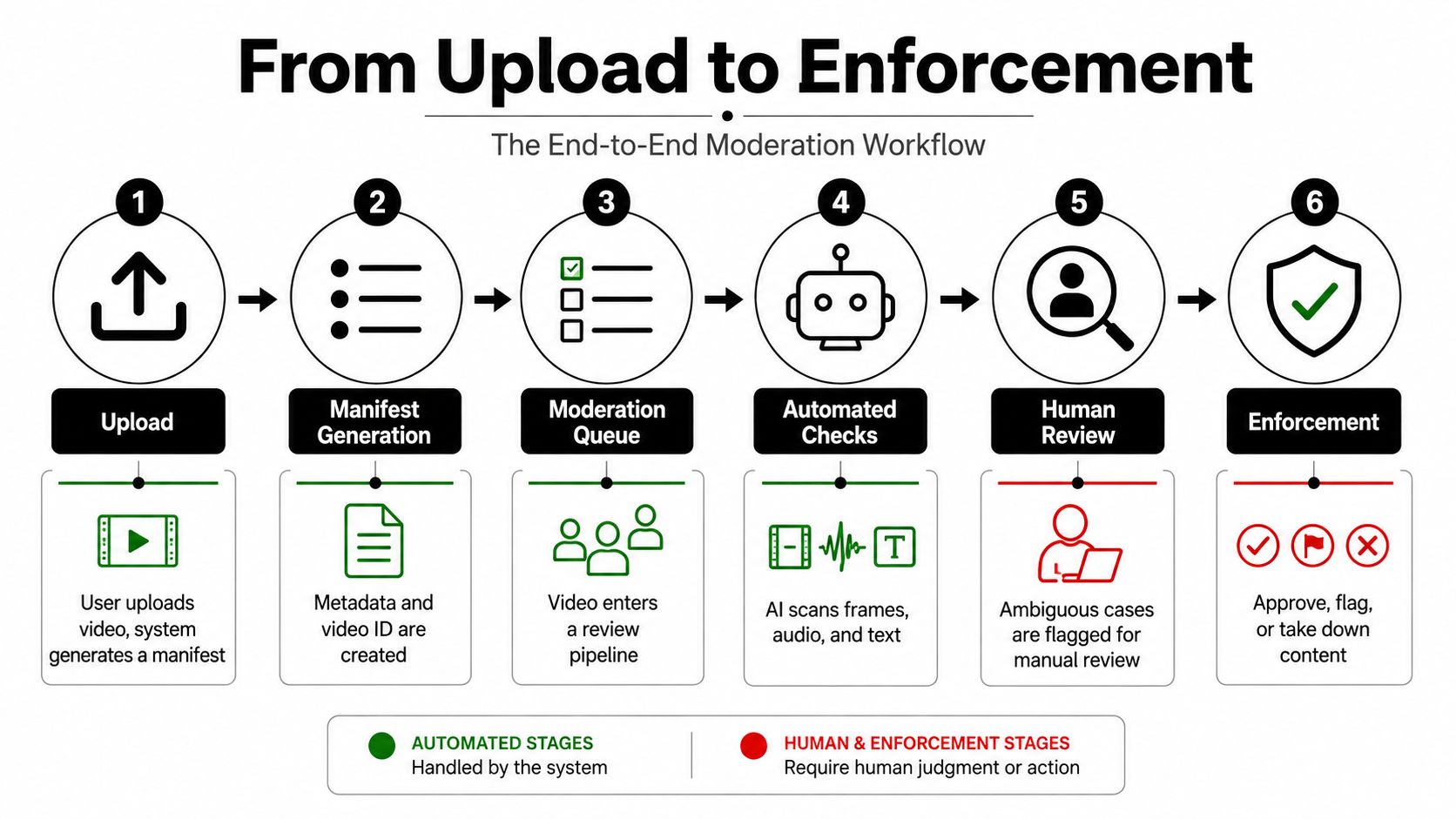
A reliable workflow begins before the first frame renders. Treat each upload as an object with a manifest, evidence trail, risk state, enforcement state, and access state. That separation lets your team restrict distribution without destroying the underlying asset or its audit history.
Start with ingestion and triage
At upload, generate a stable video identifier and manifest containing relevant metadata. Run a hash or fingerprint check against known-abuse databases before making the file available. Then send the asset through frame, audio, OCR, and metadata analysis.
The triage service should produce more than a single label. Store the policy category, confidence, evidence references, model version, and recommended action. A low-risk item can enter an approval queue, while ambiguous or severe signals should pause distribution and create a human-review task.
Separate enforcement from deletion
Enforcement can be graduated:
- Soft controls can restrict age access, reduce discoverability, require recipient authentication, or pause publication.
- Hard controls can remove the asset, suspend an account, revoke links, or block future uploads.
- Evidence controls preserve the original file, decision record, and relevant review material for an appeal or legal hold.
This distinction matters on a private platform. A moderator may need to stop one recipient from viewing a sensitive draft without deleting the source file for everyone else. Per-recipient controls can function as an enforcement layer alongside content scoring.
For teams designing the delivery experience, embedding a video should be treated as a distribution decision, not merely a presentation detail. The embed surface, domain, token, and viewer identity can all influence who receives access.
Build escalation and appeals into the same system
A reviewer overturning an automated decision must create a structured label, not just a support note. Record why the decision changed, which policy interpretation applied, whether the threshold was too strict, and whether similar assets need reprocessing.
A clear escalation path helps reviewers avoid inconsistent handoffs. Teams can use Exerta's escalation management approach as a reference when defining ownership, severity, response expectations, and closure criteria. The important design principle is local accountability. Every queue needs a named owner, and every high-impact decision needs a traceable reason.
Policies, Compliance, and the Over-Removal Trap
Moderation policy has two jobs that can conflict. It must describe what the platform won't permit, and it must explain what happens when context makes a normally restricted item legitimate. A global rulebook needs regional interpretation, language coverage, and a process for handling lawful but sensitive material.
The Digital Services Act makes moderation more auditable for covered services, while privacy obligations can create pressure to limit retention and respond to deletion requests. Copyright adds another layer, with notice-based takedowns, repeat-infringer processes, and proactive matching operating as related but distinct mechanisms. Your policy should identify which legal or contractual basis governs each action instead of placing every removal under one generic “safety” label.
The threshold decision has a human cost
Set the automated threshold too low, and the system over-removes. Documentary evidence, reporting, satire, educational material, and political discussion can disappear because the model sees a sensitive object, phrase, or scene without understanding its purpose. Set it too high, and harmful content remains available long enough to reach more people.
You can't solve that trade-off with a universal threshold. Tune it by category, audience, geography, severity, and action. A low-confidence signal may justify a warning or limited access, while a high-severity category may require temporary quarantine until a reviewer checks the context.
The safest action isn't always deletion. Sometimes it's controlled access, added context, or a short pause for review.
Public-interest exceptions need explicit policy language. YouTube raised the amount of objectionable content allowed in videos classified as being in the public interest from 25% to 50% in June 2025, with examples including city council meetings, campaign events, and political discussions, as reported by The New York Times. Your own exception policy should cover whistleblower material, documentary footage, journalism, and civic evidence, while still defining when those exceptions don't apply.
For governance teams, a regulated AI compliance guide can help organize risk ownership, documentation, human oversight, and audit preparation. On a private sharing platform, false positives can be particularly damaging because recipients already expect a trusted, deliberate exchange. Removing a legitimate client draft or training recording can break that trust faster than a public-feed ranking mistake.
Metrics, Appeals, and the Generative Video Problem
A moderation dashboard should tell you whether the system is accurate, timely, consistent, and improving. Precision measures how often flagged items really violate policy. Recall measures how much violating content the system catches. Neither metric is sufficient alone, because a detector can achieve high precision by flagging very little or high recall by creating an unmanageable review queue.
Add operational measures:
- Mean time to review, which shows how quickly people resolve escalated cases.
- Appeal overturn rate, which reveals how often the original decision conflicted with policy or user expectations.
- Queue age, which identifies unresolved exposure risk.
- Category-level error rates, which expose failures hidden by aggregate scores.
- Synthetic-content detection performance, tracked separately from ordinary duplicate or known-abuse matching.
| Metric | Target threshold | Action on breach |
|---|---|---|
| Precision | Set by policy severity and reviewer capacity | Raise or lower category thresholds after labeled review |
| Recall | Set according to the harm of missed violations | Add signals, increase sampling, or expand human review |
| Mean time to review | Define an internal service level by severity | Rebalance queues and escalate overdue cases |
| Appeal overturn rate | Establish a baseline from reviewed appeals | Audit policy wording, labels, and model drift |
| Synthetic-content signal rate | Monitor by region, cohort, and category | Investigate spikes and adjust detection or access rules |
Generative video bypasses traditional hash matching because a new file may contain synthetic faces, altered voices, or entirely generated scenes. Effective programs need several signals together, including provenance checks, watermarking, perceptual detection, behavioral signals, and human review, as outlined in guidance on moderating generative video and deepfakes.
An appeal shouldn't end at “case closed.” An upheld appeal should create a policy-review ticket, update a labeled evaluation set, and trigger a search for similar decisions. With webhooks for moderation events, a private platform can connect access changes, review outcomes, and alerts to the same operational dashboard, helping trust-and-safety leads investigate regional or audience-specific spikes before they become widespread abuse.
Implementing Moderation on a Secure Video Platform
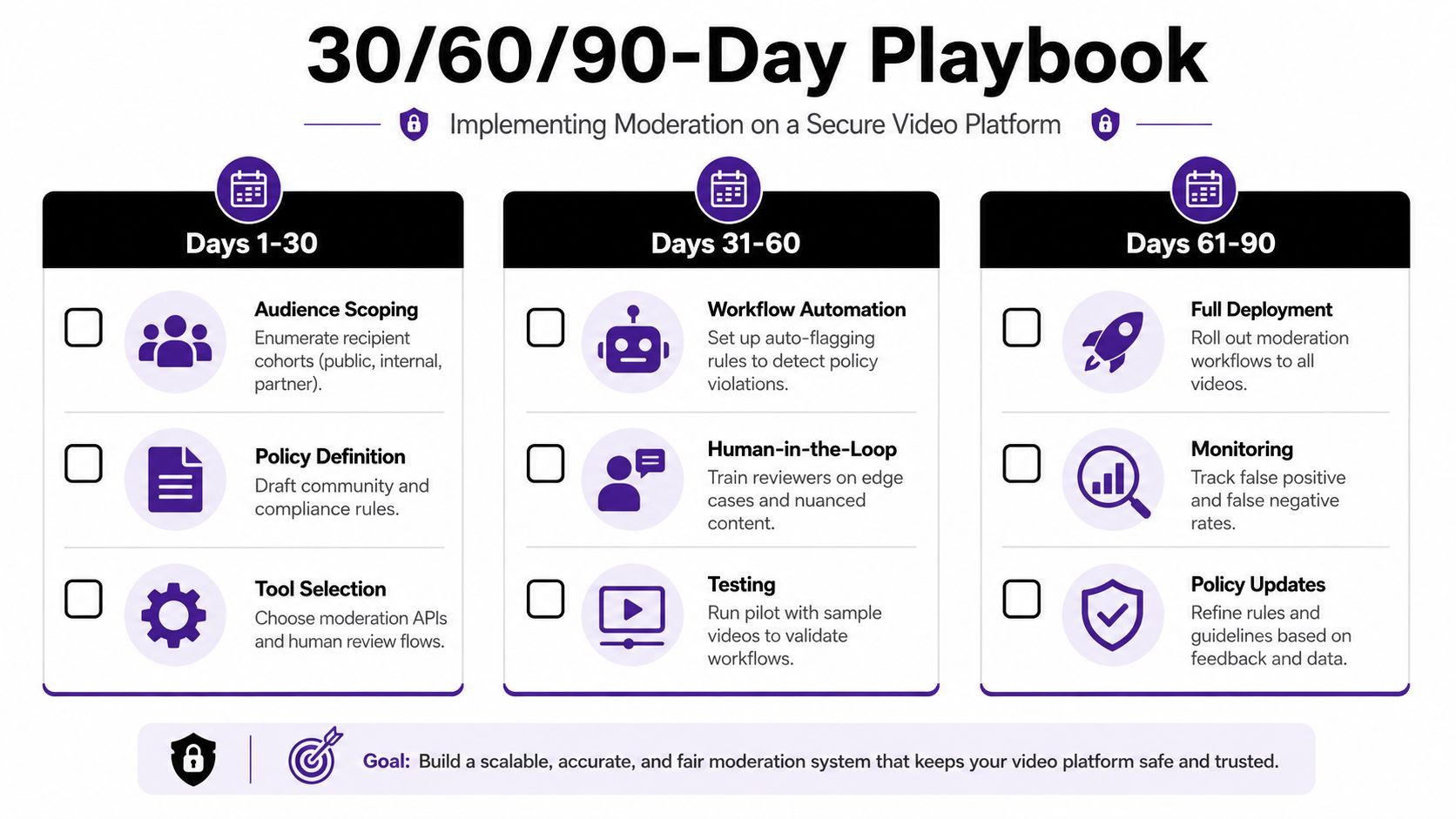
A private video platform needs a different implementation sequence from a public UGC network. Start with the recipient, not the file. List each audience cohort, define what that cohort may view, and decide which content requires scanning before delivery, ongoing audit, or post-view revocation.
Days 1 to 30 define the boundary
Create a policy matrix for internal staff, clients, partners, prospects, and public viewers. Assign each group a permission tier and document whether the user can stream, download, forward, embed, or access an expired asset.
Choose a packaged computer-vision model for predictable categories such as explicit imagery, exposed personal information, and known-abuse hashes. Add multimodal analysis for context-sensitive categories such as violence, impersonation, or fraud, but keep a human path for uncertain cases. Test the system with representative material from each recipient group, including legitimate sensitive content that shouldn't be blocked.
Days 31 to 60 connect controls to review
Automate quarantine, reviewer assignment, notification, and access revocation. Train reviewers on borderline examples, public-interest exceptions, and the difference between a content violation and an unauthorized recipient.
A secure sharing system can use signed access tokens, expiry windows, domain allow-lists, passwords, viewer registration, and watermarking to make moderation a per-recipient decision. Rather than deleting a source file after one risky sharing event, the team can revoke a specific link, narrow the allowed domain, or require a new verification step. Review secure video sharing capabilities when mapping those controls to your product requirements.
Days 61 to 90 measure and refine
Launch with a monitoring loop that separates model errors from access-policy errors. Track false positives by recipient group, sample shared items for human re-review each week, and feed the resulting labels back into threshold tuning. Review not only what the model blocked, but also what it allowed and which users received access.
The practical sequence is straightforward:
- Scope audiences: Define recipient cohorts and permission tiers.
- Write policies: Separate safety, privacy, copyright, and public-interest rules.
- Select detectors: Match each model to a specific video failure mode.
- Route uncertainty: Send borderline and high-impact cases to trained reviewers.
- Control delivery: Apply recipient-level restrictions without destroying evidence.
- Close the loop: Connect appeals, metrics, policy updates, and model evaluation.
A public platform asks whether content should remain broadly available. A secure B2B platform can often ask a narrower, safer question: which verified recipient should see it, through which channel, and until when?
vitelnk gives sales, marketing, training, and independent teams per-recipient video links, streaming-only HLS playback, passwords, expiry windows, viewer registration, watermarking, and timestamped engagement analytics. Visit vitelnk to start a controlled video-sharing workflow that treats moderation as both a content decision and an access decision.


